About this project · in English
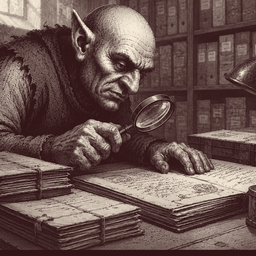
El ogro y su presa
Follow the trail of those who lived
An open archive of history teaching materials for Spanish upper-secondary education, written and maintained by one teacher. Everything here is free to download: no paywall, no advertising, no registration, no data collected in exchange for a file.
A note on language. The documents themselves — all 206 of them — are written in Spanish, because they were made for Spanish classrooms. This page exists so that readers who do not read Spanish can still understand what the project is, how it was built and how to cite it. There is no English edition of the materials, and this page does not promise one.
Behind the tangible features of the landscape, behind the tools or the machines, behind the writings that seem coldest and the institutions apparently furthest removed from the people who set them up, history means to grasp human beings. Whoever fails at that will never be more than a manual labourer of erudition. The good historian is like the ogre of the legend: wherever he scents human flesh, there he knows his prey lies.
Marc Bloch, Apologie pour l’histoire ou Métier d’historien (1949). Rendered into English for this site.
The site takes its name from that last image. Bloch wrote it while in the French Resistance, shortly before the Gestapo shot him in June 1944.
What is in the archive
The archive follows the two history subjects of the Spanish Bachillerato, the two years of upper-secondary education that precede university (students aged roughly 16 to 18). Each teaching unit holds its own documents: synthesis presentations, source dossiers, chronologies, teaching guides and the biographies described below.
First year
Contemporary World History
From the Old Regime to globalisation: twelve units covering the two centuries that made the world we live in.
12 units · 115 documents →
Second year
History of Spain
From prehistory to democratic Spain: twenty-two units, with most of the weight on the last two centuries.
22 units · 73 documents →
Vidas Paralelas: a plutarchian method
Vidas Paralelas — Parallel Lives — is the series that gives the archive its shape. It takes its name and its procedure from Plutarch: two or three lives are set side by side, told in full, and then measured against one another in a closing comparison. Plutarch called that comparison synkrisis, and it is the point of the exercise rather than an ornament at the end of it.
What is proposed here is not a revival of Plutarch's moralising, but the use of his procedure as a working method for the twenty-first century: a frame that joins microhistory, prosopography and macrohistory, so that an individual life — or a collective one — can be read against the political, social, economic, cultural and gender structures it moved through. The comparison is what makes the structures visible. A single life tells you what happened to one person; two lives put in parallel tell you what was possible, for whom, and at what cost.
Understand, do not judge
Bloch's rule, applied literally. The subjects of these biographies are read in their own terms and their own time, including — especially — the ones whose choices are hardest to forgive.
Say which is which
Documented fact, inference, hypothesis and speculation are marked apart and never allowed to blur into a single confident narrative.
No anachronism
Questions are put to the sources the sources could have answered. The past is not asked to ratify the present.
Sixty-five of these parallel lives have been published so far. Each one lives inside the teaching unit it belongs to; they are also gathered together in the series index.
A note on tools
Some of the presentations carry the visible watermark of the AI application used to produce them. That is deliberate. Where a tool has taken a substantial part in making a document, removing its mark would be like citing a source without saying where it came from.
What the machine does not do is the historian's work. It can process, correlate and suggest. Framing the questions worth putting to the sources, weighing their internal and external credibility, building and testing hypotheses, avoiding anachronism, and understanding the dead in their singularity and their dignity — that remains the author's responsibility, and the author's alone.
How to cite
Everything on the site is published under a Creative Commons BY-NC-SA 4.0 licence: use it, adapt it and share it freely for non-commercial purposes, name the author, and pass the same freedoms on. If you use a document in teaching or in research, a citation in one of these forms is all that is asked.
The archive as a whole
A single document
- Author Jesús Ignacio Bueno Madurga, PhD in History, University of Zaragoza
- ORCID iD 0009-0005-5894-6987
- Licence CC BY-NC-SA 4.0
- Language of materials Spanish
- Location Zaragoza, Spain
Who writes this
Jesús Ignacio Bueno Madurga holds a doctorate in History from the University of Zaragoza and has taught history at Bachillerato level for more than twenty-five years, currently at IES Blecua in Zaragoza. His research concerns twentieth-century Spain: the labour movement, the Second Republic and the Civil War. He is the author of a book on the social and labour history of Zaragoza (Institución Fernando el Católico, 2000).
Why all of it is open
These materials were made on hours paid for by the public. To hand them back locked away — behind a registration form, or inside a platform that charges for them — would be to keep something that is not entirely mine to keep.